172.16.252.214:4300 – A Simple Guide to Understanding This IP Address and Port
Have you ever seen something like 172.16.252.214:4300 and wondered what it means? It may look confusing at first. But don’t worry. It is much simpler than it seems.
In this guide, I will explain everything in easy words. You will learn what an IP address is, what a port number does, and why private IP addresses like 172.16.252.214:4300 are used inside networks. I will also share real examples and helpful tips from practical experience.
By the end, you will understand this clearly. Even if you are new to networking.
What Is 172.16.252.214:4300?
Let’s break it into two parts.
172.16.252.214 is an IP address.
4300 is a port number.
When we combine them, we get 172.16.252.214:4300. This means a specific device and a specific service running on that device.
Think of it like this:
-
The IP address is the house address.
-
The port number is the room inside the house.
So 172.16.252.214:4300 points to one exact room inside one exact house on a network.
This format is very common in local networks. It helps computers talk to each other clearly.
Understanding Private IP Addresses
The IP address 172.16.252.214 belongs to a private range.
Private IP ranges include:
-
10.0.0.0 – 10.255.255.255
-
172.16.0.0 – 172.31.255.255
-
192.168.0.0 – 192.168.255.255
Since 172.16.252.214 falls inside 172.16.0.0 to 172.31.255.255, it is a private IP.
Private IP addresses are not used on the public internet. They are used inside:
-
Offices
-
Schools
-
Homes
-
Company networks
That means 172.16.252.214:4300 is most likely part of an internal system.
What Does Port 4300 Mean?
Now let’s talk about port 4300.
A port is like a door. Each door allows a different service.
Some common ports are:
-
80 for HTTP
-
443 for HTTPS
-
22 for SSH
-
3306 for MySQL
Port 4300 is not a standard web port. It is usually used by custom applications.
For example:
-
A development server
-
A local dashboard
-
A company tool
-
A testing application
So when you see 172.16.252.214:4300, it likely means a custom service is running there.
Why Companies Use 172.16.252.214:4300
From real-world experience, companies use private IPs like this for many reasons.
First, security. Private IP addresses cannot be accessed directly from the internet.
Second, control. Internal tools do not need public exposure.
Third, cost savings. No need for public hosting.
For example, I once worked on a system where developers accessed a local app through something like 172.16.252.214:4300. It was used only inside the office network.
It helped the team test software before launching it publicly.
How Devices Connect to 172.16.252.214:4300
To access this address, your device must:
-
Be connected to the same local network.
-
Have permission to access that service.
-
Know that port 4300 is open.
If you type http://172.16.252.214:4300 in a browser, one of three things may happen:
-
The page loads.
-
You see a login screen.
-
You get a connection error.
If it loads, that means the service is active.
If not, the server might be offline or the port may be blocked.
Common Uses of Port 4300 in Development
In many cases, port 4300 is used during software development.
Developers often run apps locally on ports like:
-
3000
-
4200
-
4300
-
5000
For example, some Angular or Node.js projects can be configured to run on port 4300.
So 172.16.252.214:4300 could be a web app under testing.
It may not be meant for public use.
Is 172.16.252.214:4300 Safe?
Good question.
Private IP addresses are safer than public ones. But safety still depends on setup.
Here are some safety points:
-
Is there password protection?
-
Is the firewall enabled?
-
Are only trusted users allowed?
-
Is the port open only internally?
If configured properly, 172.16.252.214:4300 can be very secure.
However, poor configuration can create risks inside the network.
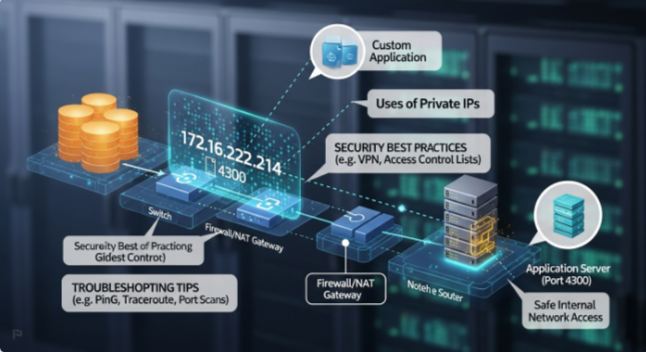
Troubleshooting Connection Issues
Sometimes you may not be able to access 172.16.252.214:4300.
Here are simple steps to check:
-
Make sure you are on the same network.
-
Ping the IP address.
-
Check if port 4300 is open.
-
Ask the network administrator.
-
Restart the service if needed.
In many cases, the issue is simple. Maybe the server is turned off. Or the firewall blocks the port.
Do not panic. Start with basic checks.
Difference Between Public and Private IP with Ports
Let’s compare.
Public example:
203.0.113.5:80
Private example:
172.16.252.214:4300
Public IP addresses can be accessed from anywhere.
Private IP addresses work only inside local networks.
So 172.16.252.214:4300 is not visible to the world.
This is why businesses use private addressing for internal systems.
How Network Address Translation (NAT) Works
NAT is important here.
When devices inside a private network access the internet, NAT changes their private IP to a public IP.
But internal services like 172.16.252.214:4300 stay inside.
They are not shared publicly unless port forwarding is configured.
This adds another layer of protection.
Real Example of Using 172.16.252.214:4300
Let me share a simple example.
Imagine a school has a student portal.
The server runs at 172.16.252.214:4300.
Students inside the computer lab can open the portal.
But people outside the school cannot access it.
This keeps the system safe and private.
I have seen similar setups in offices and training centers.
Best Practices for Managing Internal IP Services
If you manage a system like 172.16.252.214:4300, follow these tips:
-
Use strong passwords.
-
Keep software updated.
-
Monitor network traffic.
-
Limit user access.
-
Document configurations.
These small steps improve security and reliability.
Internal systems are important. Treat them seriously.
SEO and Technical Relevance of 172.16.252.214:4300
From an SEO view, private IP addresses do not rank in Google.
They are not public websites.
But technical searches about 172.16.252.214:4300 often relate to:
-
Network configuration
-
Local server access
-
Port troubleshooting
-
Development server issues
-
Internal IP security
So this topic is helpful for IT students and beginners.
Frequently Asked Questions (FAQs)
1. What type of IP address is 172.16.252.214?
It is a private IPv4 address. It belongs to the 172.16.0.0 – 172.31.255.255 range.
2. Can I access 172.16.252.214:4300 from the internet?
No. Not unless port forwarding or VPN is configured.
3. What does port 4300 usually do?
Port 4300 is often used for custom apps or development servers.
4. Why am I getting a connection error?
You may not be on the same network. The server may also be offline.
5. Is this IP address dangerous?
No. It is just a private network address. Risk depends on setup.
6. How do I find who owns 172.16.252.214?
Since it is private, it belongs to a local network. Ask the network administrator.
Final Thoughts on 172.16.252.214:4300
At first, 172.16.252.214:4300 may look technical and confusing. But now you know the truth.
It is simply:
-
A private IP address
-
Combined with a port number
-
Used inside a local network
Understanding this helps you feel more confident with networking basics.
If you are learning IT or web development, this knowledge is very useful.
Next time you see something like 172.16.252.214:4300, you will not feel confused. You will understand exactly what it means.